Home Glossary Average win / average loss ratio
Average win / average loss ratio
Average win / average loss ratio — Your average winning trade divided by your average losing trade — how much bigger a typical win is than a typical loss.
This is the other half of the win-rate conversation. On its own it is as useless as win rate is; together they are the whole edge.
In plain English
Average up your winning trades. Average up your losing trades, ignoring the sign. Divide. A payoff ratio of 1.52 means a typical win is about one and a half times the size of a typical loss.
Almost every profitable retail account is profitable through one of two shapes: a high win rate with a payoff below 1.0, or a low win rate with a payoff well above it. Neither is better. What matters is that the pair clears the break-even line — and the line is easy to compute: at payoff P, you break even at a win rate of 1 ÷ (1 + P).
It is often confused with reward-to-risk ratio, and it is not the same thing. Reward-to-risk is what you planned — target distance over stop distance, decided before entry. Payoff is what actually happened after every early exit, every trailed stop and every trade you closed out of boredom. The gap between the two is one of the most useful things a journal can show you, and it is normally larger than people expect.
The formula
Payoff ratio = average winning trade ÷ |average losing trade|
- Both averages are of net results, after commission and swap.
- Break-even win rate = 1 ÷ (1 + payoff).
- Expectancy = (win rate × average win) − (loss rate × average loss).
If you have no losing trades the ratio is undefined; TapeSheet shows ∞ rather than a made-up figure.
Worked example — the demo account
The demo account:
| Average win (49 trades) | $238.63 | |
|---|---|---|
| Average loss (47 trades) | $157.44 | |
| Payoff ratio | 1.52 | 238.63 ÷ 157.44 |
| Break-even win rate | 39.7% | |
| Actual win rate | 51.04% |
A payoff of 1.52 needs a 39.7% win rate to break even; the account achieves 51.04%.
That is the edge, stated completely, in two numbers. Everything else on the dashboard is a different view of the same fact or a warning about how fragile it is.
One sanity check worth running on your own statement: compare this ratio against the reward-to-risk you believe you trade. If you plan 2:1 setups and your realised payoff is 1.1, you are systematically taking profit early — and that gap, multiplied across a few hundred trades, is usually larger than any other single leak in the account.
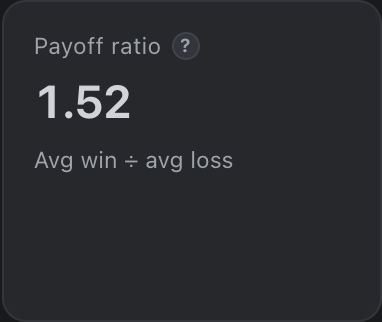
Every figure above is from the demo account TapeSheet ships with — 96 closed trades, generated from a fixed seed. Open the same account →
What this does not tell you
The caveat is the part worth reading, which is why it sits next to the number rather than in a footer.
- It is not your reward-to-risk ratio. It is the realised outcome, not the plan. Comparing the two is the point; treating them as interchangeable hides the leak.
- Averages are wrecked by outliers. One enormous winner lifts the average win and makes the ratio look structural when it was a single event. Check it against the median, and check what happens when you remove your best trade.
- It says nothing about frequency. A payoff of 3.0 achieved twice a year is not a business.
- It cannot see the trades you did not close. Holding losers open keeps them out of the average loss entirely, which flatters this ratio and your win rate at the same time.
Where TapeSheet shows it
The Payoff ratio tile on the Overview, with average win and average loss also printed under the Expectancy tile. It is 15% of the Tape Score.
Related terms
See your own statement, analyzed
Drop an MT4 or MT5 statement on the page and the whole dashboard renders in about three seconds. No signup, no upload — the file is parsed inside your browser tab and never leaves your device.
Analyze my statementAll glossary terms ·Free trading journal ·MT4 statement analyzer ·MT5 report analyzer