Lot
Lot — The unit of position size in forex — one standard lot is 100,000 units of the base currency.
Lot size is the least discussed and most consequential number in a trade. Entry technique gets the attention; position size does most of the damage.
In plain English
A standard lot is 100,000 units of the base currency — the first currency in the pair. Buy one standard lot of EURUSD and you are long 100,000 euros. A mini lot is 10,000 units (0.10 lots), a micro lot is 1,000 (0.01 lots), and most brokers accept 0.01 as the minimum increment.
MT4 and MT5 statements record position size in the “Size” or “Volume” column, in lots. A row reading 0.79 is 79,000 units of the base currency — brokers allow arbitrary two-decimal sizes, not just the round tiers.
For a pair quoted against the US dollar, lot size and pip value are directly proportional: one standard lot is $10 per pip, so 0.79 lots is $7.90. That proportionality is why doubling your size doubles both your profit and your loss, and why it is the fastest way to change the shape of an account in either direction. The lot size chart prices it at every tier — every lot size against 1, 10, 100 and 1,000 pips.
Leverage is a separate concept that is frequently conflated with this one. Leverage determines the margin your broker requires to hold a position; lot size determines how much money each price movement is worth. You can be over-sized on low leverage and conservatively sized on high leverage. It is the lot size that does the damage.
The formula
Units = lots × 100,000 · Pip value (USD-quoted pairs) = lots × $10 · Money risked = lots × $10 × stop distance in pips
- Standard lot 1.00 = 100,000 units · mini 0.10 = 10,000 · micro 0.01 = 1,000.
- To size a position from risk: lots = (amount you are willing to lose) ÷ ($10 × stop distance in pips).
- For non-USD-quoted pairs, substitute the converted pip value.
That middle line is the one worth memorising. Risk $200 with a 40-pip stop on EURUSD: 200 ÷ (10 × 40) = 0.50 lots.
Worked example — the demo account
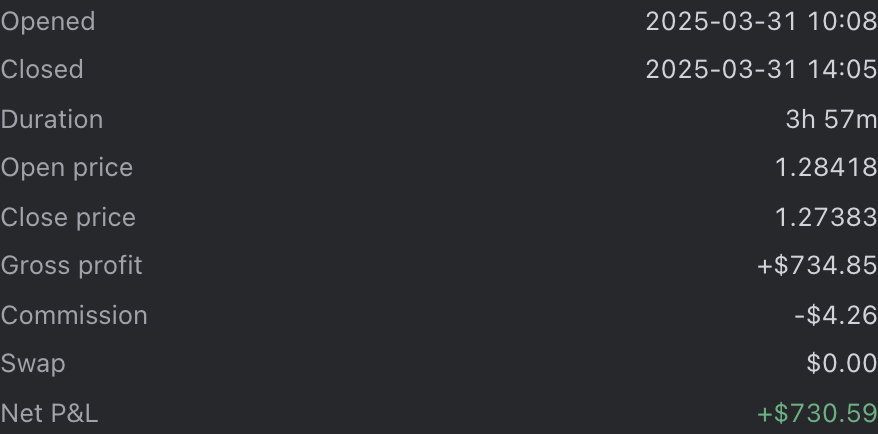
The same demo trade, read as a sizing decision rather than an outcome — ticket #900087, GBPUSD short:
| Size on the statement | 0.79 lots | |
|---|---|---|
| Units of GBP | 79,000 | 0.79 × 100,000 |
| Pip value | $7.90 per pip | |
| Move captured | 65.2 pips | |
| Net result | +$730.59 | |
| Had it been 0.10 lots | +$65.20 gross | same analysis, same discipline, one eighth the outcome |
Identical trade, identical decision quality — the size chose the size of the outcome.
Which cuts both ways, and the cut that matters is the other one. The demo account’s worst trade lost −$393.41; at a quarter of the size it would have lost $82. Nothing about the analysis would have differed.
Across the demo account, position sizes range from 0.05 to 0.90 lots — an eighteen-fold spread. That variation is one reason the standard deviation of results is $240.49 against an expectancy of +$44.72, and it is why reviewing in R-multiples rather than currency is worth the effort: R divides the sizing back out.
Every figure above is from the demo account TapeSheet ships with — 96 closed trades, generated from a fixed seed. Open the same account →
What this does not tell you
The caveat is the part worth reading, which is why it sits next to the number rather than in a footer.
- Lot size is not risk. Risk is lot size × stop distance. One lot with a 5-pip stop risks less than 0.1 lots with a 100-pip stop. Reviewing sizes without stops tells you nothing.
- The statement’s size column does not show partial closes cleanly. MT5 in particular reports deals rather than positions; TapeSheet reconstructs positions FIFO, but a partially closed trade can still look odd in the raw file.
- It says nothing about correlation. Three 0.5-lot longs in EURUSD, GBPUSD and AUDUSD are not three positions, they are approximately one 1.5-lot short-dollar position. Statements have no concept of this and neither does any per-trade metric.
- Lots do not translate across asset classes. One lot of gold, one lot of US30 and one lot of EURUSD are entirely different exposures. The contract specification is the only authority, and it is set per broker.
Where TapeSheet shows it
Every trade’s size is in the Trades table and its detail drawer, and there is a lots total in the per-symbol breakdown. If you enter planned risk on a trade, TapeSheet computes the R-multiple that makes trades of different sizes comparable — which is the reason lot size stops mattering once your review is in R.
Related terms
See your own statement, analyzed
Drop an MT4 or MT5 statement on the page and the whole dashboard renders in about three seconds. No signup, no upload — the file is parsed inside your browser tab and never leaves your device.
Analyze my statementAll glossary terms ·Free trading journal ·MT4 statement analyzer ·MT5 report analyzer